Stop Losing Revenue to Denied Claims
Denied claims are draining revenue from healthcare practices — and with 41% of providers now reporting denial rates above 10%, the real problem isn't the denial itself, it's what happens after.
Every healthcare practice has a number nobody likes to talk about. It sits quietly in the accounts receivable report, grows a little each month, and eventually gets written off as uncollectible. That number is denied and abandoned claims — and for most practices, it represents a significant chunk of revenue that never had to disappear in the first place. According to Experian Health's 2025 State of Claims report, 41% of providers now say more than one in ten claims gets denied — up from just 30% three years ago.
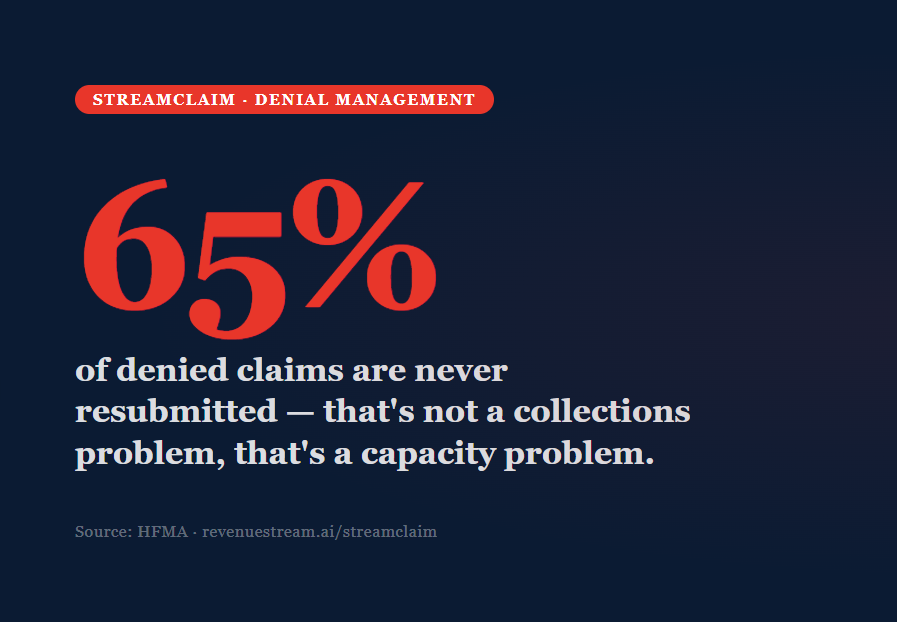
The uncomfortable truth is that most of this lost revenue is recoverable. According to the HFMA, up to 65% of denied claims are never resubmitted — not because the denial was valid, but because the resubmission process is too time-consuming for an already stretched billing team.
These numbers reflect a revenue cycle under pressure — and they are exactly the problem RevenueStreamAI built StreamClaim to solve. Practices using StreamClaim stop abandoning revenue that was earned, documented, and owed.
The Claim Gets Denied. Then What?
Picture a typical Tuesday in your billing department. A stack of claim denials comes in from three different payers. Some are for missing modifiers. Some cite authorization issues. One has a vague code that just says "insufficient documentation." Your billing team is already behind on submitting new claims, fielding patient calls, and handling prior auth requests.
So the denied claims sit. Then they age. Then someone decides the cost of reworking them outweighs the potential recovery, and they get written off.
This is not a staffing failure. It is a systems failure. And it happens in practices of every size, every specialty, every day.
What the Numbers Actually Say
According to Kodiak Solutions' March 2026 report, US hospitals lost $48 billion in net revenue to final denials and bad debt in 2025, up 25% year over year, driven largely by clinical and prior-authorization denials. And HFMA data confirm that up to 65% of denied claims are never resubmitted.
Every one of those abandoned claims represents real revenue. Revenue from care your providers already delivered. Revenue from patients you already treated. Revenue that, with the right process, could come back to your practice instead of being written off forever.
The problem is not that the revenue is gone. The problem is that recovering it requires more bandwidth than most billing teams have.
Up to 65% of denied claims are never resubmitted. That is not a collections problem. That is a capacity problem — and it has a solution.
Why Manual Denial Management Does Not Scale
Denial management sounds straightforward in theory. A claim gets denied, you identify the reason, you fix it, and you resubmit. Simple.
In practice, it is anything but. Each payer has its own denial codes, its own appeal formats, its own deadlines, and its own documentation requirements. A denial from UnitedHealthcare looks nothing like one from Aetna. What works for Blue Cross may not work for Cigna. Keeping track of all of this manually is a full-time job — several full-time jobs, depending on your claim volume.
And here is the part that stings: even when your team does everything right, payers sometimes deny claims anyway. Not because the claim is wrong, but because the system is designed to make resubmission difficult enough that practices give up.
Most practices give up. And that is where revenue disappears permanently.
The Most Common Reasons Denials Go Unworked

How StreamClaim Changes the Math
StreamClaim is RevenueStreamAI's AI-powered claims and denial management module, and it approaches the problem differently from anything a manual process can deliver.

When a claim gets denied, StreamClaim does not wait for a billing staff member to notice it, categorize it, and queue it for rework. It identifies the denial automatically, analyzes the reason code, and generates an AI-assisted appeal brief — formatted to that specific payer's requirements. The whole process starts within minutes of the denial arriving, not days or weeks later.
That speed matters. Payer appeal windows are finite. The longer a denial sits, the closer it gets to the point where the revenue is legally unrecoverable. StreamClaim keeps the clock from running out.
The AI Appeal Brief — What That Actually Means
When StreamClaim generates an appeal, it pulls together the relevant clinical and billing documentation, cross-references the denial reason against the payer's own coverage policies, and produces a structured brief that directly addresses the reason for denial.
This is not a generic template. It is a targeted response built for that specific claim, that specific payer, and that specific denial code. The appeal goes out faster, carries more weight, and has a higher likelihood of overturning the denial than a manually written response. For your billing team, this means less time spent researching payer policies and writing appeals from scratch — and more time focused on the cases that genuinely require human judgment.
Clean Claims Before They Even Leave
StreamClaim also works on the front end of the process, before claims are submitted at all. Its AI validation engine runs every claim through more than 4,000 edits before submission — checking for coding errors, modifier issues, missing documentation flags, and payer-specific rule conflicts.
A claim that passes those checks is a clean claim. And a clean claim is far more likely to get paid on the first submission than one that gets flagged on the payer's end.
Reducing first-pass denials is not just about efficiency. It is about protecting revenue at the point where it is most vulnerable. Every claim that gets denied costs your practice time and money to recover — if it gets recovered at all. Stopping the denial before it happens is always the better outcome.
StreamClaim submits claims via 837P and 837I transactions, runs 4,000+ pre-submission edits, and generates payer-specific AI appeal briefs for denied claims — all within a HIPAA-compliant workflow. When a denial arrives, StreamClaim classifies the reason code, assembles the clinical documentation, and routes the appeal automatically. Your billing team reviews and approves, not builds from scratch.

What Recovery Actually Looks Like
Practices using StreamClaim consistently recover previously denied revenue that would otherwise be written off — through a combination of successful appeal reversals, reduced first-pass denial rates, and faster resubmission timelines.
For a mid-size group practice, that kind of recovery does not just improve the revenue line — it changes what the practice can afford to do. More staff. Better equipment. Less financial pressure on leadership. The math compounds quickly when you stop writing off claims that could have been won.
A Word on the Patient Relationship
Denied claims do not just affect your bottom line. They affect patients too. When a claim gets denied and nobody follows up, patients sometimes receive unexpected bills months later with no context. That erodes trust. Practices that resolve denials quickly and accurately protect both their revenue and their patient relationships.
The RevenueStreamAI Advantage
The care has already been delivered. The documentation is already in the chart. The only thing standing between your practice and that revenue is a process that is fast enough, accurate enough, and persistent enough to see every denial through to resolution.
StreamClaim is built to be that process. It does not replace your billing team — it gives them the infrastructure to stop leaving revenue on the table and start recovering what your practice has already earned. Your providers worked for that revenue. It is time to go get it back.
Stop Writing Off Revenue You Have Already Earned
Find out exactly where your claims process is costing you revenue. Our RCM team will audit your current denial management workflow and show you a clear path to higher recovery rates.
 RevenueStreamAI — The AI Revenue Cycle Operating System for Healthcare